
“invisible string”* (Nikki’s Version)
When God is gone . . .

Click below to hear Nichole read this piece.
Friends,
On a walk recently, a glimmer of gold caught my eye. Three brave daffodils broke through high plains clay to welcome spring—right on cue. Brave because, here in the shadow of the Rockies, they must know that snow will still fly.
Then what?
“I know the value of a spring flower,” writes Catherine McNiel in Mid-Faith Crisis, her new book with Jason Hague, “for I have survived the long, dark hours of winter’s death.”1 Dear friends, I feel this: Spring roared in like a lion here. As much as we cling to the second part of that grammar-school proverb about March, life teaches us not to. I’ll be honest. It’s the end of April and still all lions here: in the headlines, in the angry eyes of the driver tailing me, and there’s more crouching in the tall grasses of May. Tell me, what self-respecting lamb will share pasture with that?
Maybe you can relate. Mary could.
“Lord, if you had been here . . .” she lamented to Jesus over the death of her brother, Lazarus. “If you had been here” we echo Mary with the lions closing in.
So, I’m going to wrap up this series on “Mary’s near the Cross” using a frayed and fragile bow; with more questions than answers. And—true to the series—Taylor Swift will join us, too. (Click here for her beautiful song.) It’s not lost on me that this piece rolls out on the heels of Holy Week, or that my neighbor brought a bouquet of blooming daffodils to our door.
Like an invisible string . . .
-nikki
“I figured something was sideways. You went radio silent.” My friend’s voice spilled out with careful compassion.
She knows me too well.
What do you do when the ground shakes beneath your feet? When the news you prayed you’d never hear rings in your ears? When the God who comes near responds with an out-of-office reply?
I get quiet.
Then, I run
. . . to South Dakota—the default for spring breakers in search of balmy, sunlit days.
“I need to go somewhere. Anywhere,” I tell my husband, “But home.”
Mt. Rushmore is bone cold,
as we pry ourselves from the car and search for coats among M&M wrappers and Kleenex wads. My son yawns, then decompresses like a Christmas inflatable. His friend is diving in Bonaire, “but there’s an indoor water park in Rapid City,” was my carrot for him to endure a day’s drive across eastern Wyoming. It wasn’t all bad: Along the way we stopped at historic Fort Laramie (my bucket list, not his), complete with a 20-minute movie about westward expansion. He left 2 minutes in. That, and my son can tell his kids someday that he peed on the Oregon Trail.
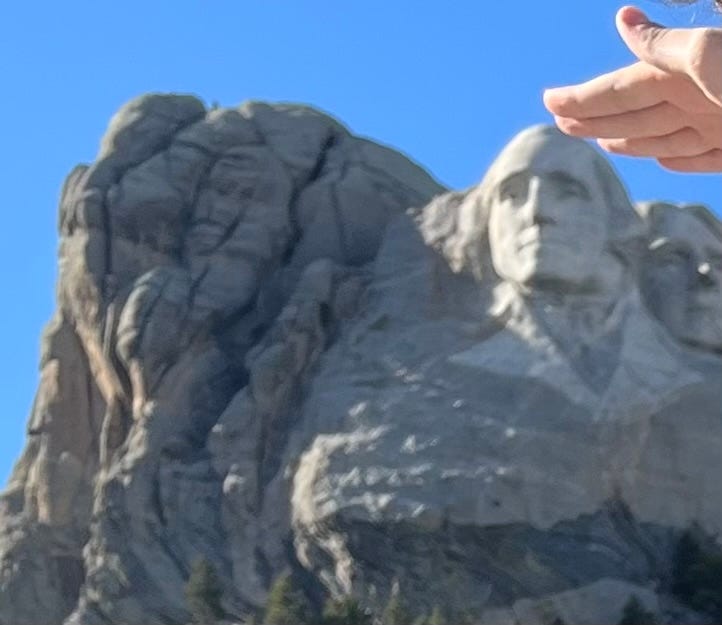
We round the bend of the Rushmore parking lot and look up. Four men, set in granite, stare stoically across the Black Hills—the sacred land of the Lakota Sioux.
Somehow, it all feels wrong.
I wander through the visitor center, highlighting Rushmore as a feat of human ingenuity and perseverance, and wonder if that’s what draws over 2 million visitors every year. And me.
But, there’s always more to the story—to this one and everyone’s. A treaty signed at Fort Laramie, where we stood hours before, promised the Sioux and Arapaho Nations space in the Black Hills if they relinquished their other lands. The treaty, it turns out, was not as good as Black Hills gold. Once discovered, white settlers poured into the promised lands despite the promises. What followed was one more bloody and brutal chapter in American history. Treaty violations were nothing new to the Sioux. But carving out four US presidents to permanently preside over their sacred space?
What am I doing here?
Run far enough from the epicenter of your pain, and you only feel the tremors.
We exit the visitor center. I snap a selfie patting George Washington’s head.
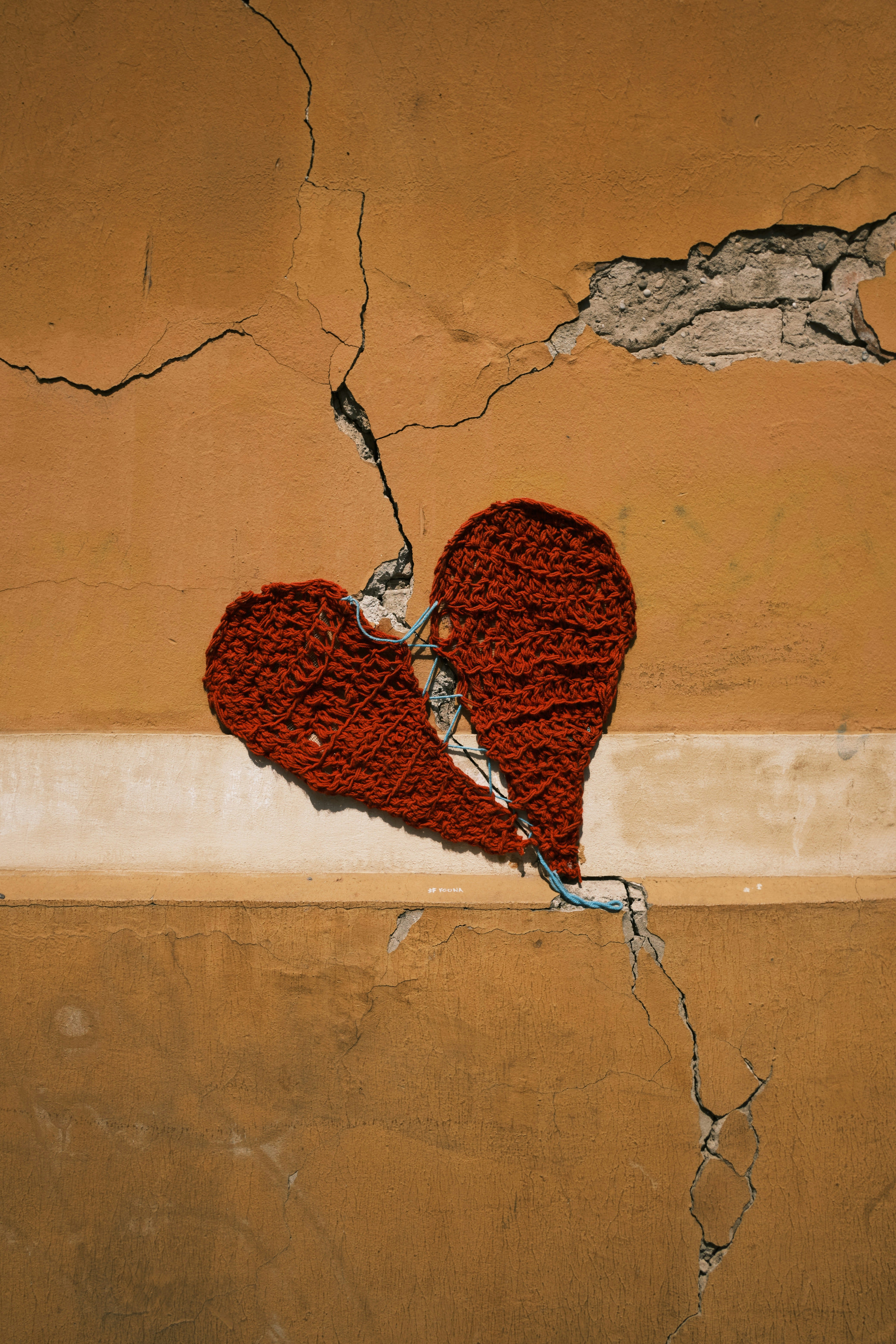
If you look close enough, you’ll see cracks across the Rushmore faces. Hearts and promises are like that: Sometimes, they split in two. Other times a finite fracture creeps quietly along. Either way, they break and we’re left to salvage meaning from it all.
Sometimes we can’t.
***
Mary of Bethany’s heart lied in pieces on the floor. The same floor where she earlier sat at the Teacher’s feet as her sister, Martha, served. “Lord, the one you love is sick,” was the message sent, pleading for Jesus’ return in time to save their dying brother. But Lazarus was lost. And Jesus? Nowhere to be found. When the Rabbi did show, His friend’s body was four-days cold in the tomb. As soon as she heard of Jesus’ return to Bethany, Martha left to meet Him.
***
It’s not yet noon on day two of our South Dakota foray, and my son is done. Was it a 6:30 AM alarm, in clear violation of Spring Break sleep-in protocol? The two-hour wait to tour Wind Cave National Park and plunge down a wobbly elevator shaft? Or that what we actually discovered was cave acoustics from shrieking toddlers instead of Black Hills gold?
He’s done, but I can’t be. Not yet.
Move fast enough and your pain blurs into the background.
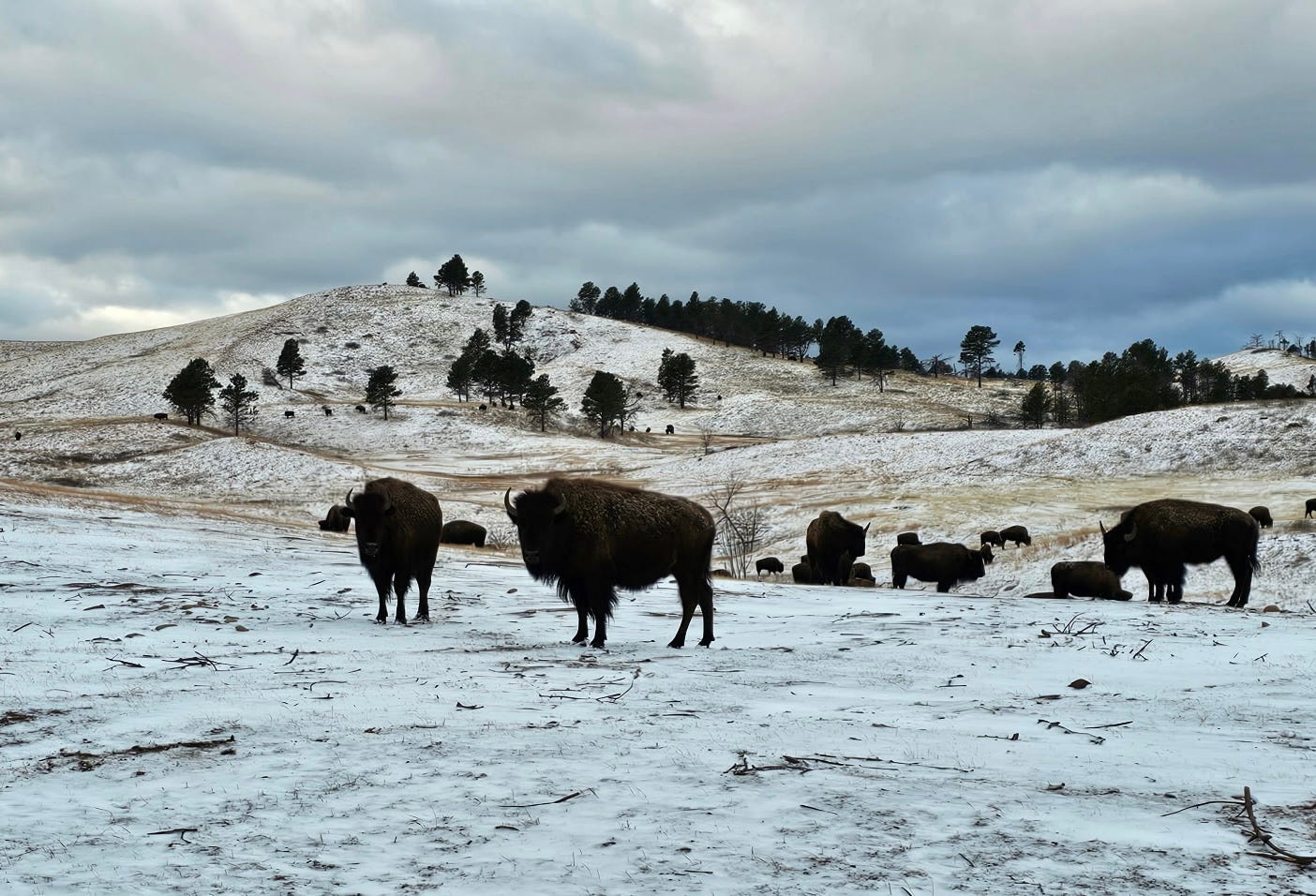
Above Wind Cave, buffalo graze below a steel-gray sky. They’re not in a hurry, even as our SUV creeps towards them on the gravel road.
We wait. They were here first, after all.
I try to imagine miles of open space blanketed in bison herds—like the park’s film described—before they were almost annihilated by settlers moving west. As their numbers dwindled, so did the livelihood of many Native Americans dependent on them for food and shelter. Only a small remnant of these herds remains. I want to sermonize this story for my son so he can see it too. But there were cushioned chairs in the park auditorium and my coat for a blanket.
The last bull ambles across the road, and I ache for a redemption arc: even the thinnest thread that could connect this sacred space of caverns below with the legacies above. Is it selfish to want one too? Because the pain followed me here, even 300 miles away. I cradle the disposable cup in my hands like it’s as warm as it was three hours ago. A final sip of imitation vanilla and coffee goes down cold. I stare into the empty vessel, caked with residue.
I feel empty. Like that.
***
Lazarus lay silent and still inside the cave that was his tomb. After Martha spoke with Jesus, she returned for Mary: “‘The Teacher is here,’ she said, ‘and is asking for you.’” When she reached the outskirts of Bethany, Mary fell at Jesus’ feet, again, echoing her sister’s lament: “Lord, if you had been here, my brother would not have died.” Mary wept even as Jesus’ sorrow welled up within Him for this family he loved. “Where have you laid him?” Jesus asked.
Then He wept, too.
In moments Jesus stood at the cave’s entrance and ordered the entry stone moved. Martha objected, but Jesus answered,
“Did I not say to you that if you believe, you will see the glory of God?”
Jesus looked up to heaven and His Father, and then called to their dead brother in the cave, “Lazarus, come out.” He did, his hands and feet still bound with linen. Then many believed.
Did Mary?
***
The sun sneaks through cracks in a porcelain-grey sky as we pull into the Crazy Horse Memorial parking lot. My son forgoes “another visitor center with another movie” to sleep in the car. I breathe in the brisk Dakota air, and turn back for my coat. That’s when I see him: Lakota warrior Crazy Horse, with his granite arm extended over Thunderhead Mountain. He points across sacred land, renamed “Custer County,” ironically, for the general he crushed at Little Bighorn.

Five minutes into this “another movie” and maybe I finally know what I’m doing here. The monument on this mountain, begun in 1948, is still in its first draft. Earlier, Luther Standing Bear wrote to Rushmore’s head sculptor, stating that Crazy Horse should appear alongside presidents Washington and Lincoln. He received no response, but his brother—Chief Standing Bear—invited Korczak Ziolkowski (another Rushmore alum) to sculpt Crazy Horse elsewhere in the Black Hills.
Ziolkowski embraced the vision, and committed the rest of his life to it. Almost 80 years later, the sculpture remains unfinished. If you’re planning on holding your breath for its completion, don’t: The head, arm, hands, and fingers of Crazy Horse crest Thunderhead’s summit now. His torso, and the horse he sits astride, still lie hidden in stone. It’s a slow unveiling that persists without federal funding.
But, somehow, this all feels right.
***
Six days before Passover, a resurrected Lazarus joined his Deliverer at the table. Mary? Once again, she found herself at Jesus’ feet. Did she know that the One who brought her brother back to life would soon offer up his own? We don’t know. What we can observe is that somewhere between hope and despair, an occupied tomb and an empty one, Mary saw it: the thread of God’s presence in her pain—one that somehow unveiled His glory . . .
When she chose to sit at Jesus’ feet while her sister served,
when she fell at them to grieve her dead brother,
as she poured perfume over Jesus’ feet now.
Mary “honors him,” Laura Price Hall observes, “not for the miracle he has just performed raising Lazarus from the dead, but because he will walk the way unto death. The feet she pours the oil on are the feet that will be pierced in the crucifixion.”2 In his Gospel account, John writes that as Mary poured the perfume—about a year’s worth of wages—on Jesus’ feet and dried them with her hair, “the house was filled with the fragrance of the perfume.”
Did she stare into the empty vessel and still feel full?
“One single thread of gold tied me to you.”
-Taylor Swift/ “invisible string”
Wyoming wind is the fair-weather friend you think you have, but don’t really: She prods you on—so long as you’re both headed in the same direction. But today she sweeps in sideways, angrily rocking our car as we drive home. My son falls asleep with a pile of sugar and Red 40 gas-station loot in his lap while tumbleweeds roll across a vacant prairie and play chicken with our car. Taylor Swift contraband spills through the speakers while he sleeps. (I choose my battles.)
Even with Taylor, it’s impossible to hide in these open spaces. Here, you can only just be. I think of the home we’re headed to. How a voice trembled on the line as she told me the news, and then the earth beneath my feet. How my heart still lies in pieces on our hardwood floor.
“Lord, if you had been here,” it cried out as it fractured.
But here, in these wide-open spaces, I think maybe He was:
In a friend’s text that morning. (“I’m praying.”)
In the *rescheduled* coffee with a mentor who had walked this path before. (“I learned to pray for God’s will, instead of my own.”)
In the voice of a sister who called that afternoon. (“I just felt like we should talk today.”)
In the words I “happened” to find on my feed the day after, for when a loss is irreversible: “This is the place Jesus knows.” (Thank-you Kimberly Penrod Pelletier3.)
I grip the steering wheel tighter and brace for the next wind gust. My eyes scan the horizon for a redemption arc, but these plains are empty. Even the buffalo are gone.
Sometimes you just don’t get one.
Sometimes all you get is just a glimpse of an otherwise invisible string.
*Title Credit: “invisible string” is an original song by Taylor Swift:
Taylor Swift. “invisible string,” track 11 on Folklore, Republic Records, 2020.
McNiel, Catherine and Hague, Jason, Mid-Faith Crisis: Finding a Path Through Doubt, Disillusionment, and Dead Ends (Downers Grove, IL: InterVarsity Press, 2025), 170.
Price-Hall, Laura. Sermon, Peak Community Church, Fort Collins, CO, April 6, 2025.
Penrod Pelletier, Kimberly. “God is Already Working In Ways You’ve Yet to Imagine,” (in), Mar 8, 2025, https://incourage.me/2025/03/god-is-already-working-in-ways-youve-yet-to-imagine.html.
Pull Quote reference for “invisible string":
Taylor Swift. “invisible string,” track 11 on Folklore, Republic Records, 2020.
Images
Header Image: Ante Gudelj on Unsplash.
Mount Rushmore and Crazy Horse Memorial Images: Nichole Woo.
Buffalo above Wind Cave National Park: G. Miller.
Audio
Background Music: music_for_video from Pixabay.
Narrated by Nichole Woo (Resonate Studios)
...when a loss is irreversible: “This is the place Jesus knows.” That will stick with me...as will your honesty in pain. Love.
I don't know the specifics of your pain but I'm praying for you, friend. I love your writing and appreciate your vulnerability here.